


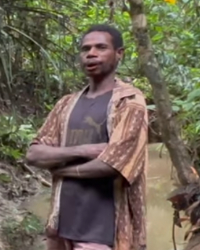

The Tanguat people are an indigenous ethnic group of Papua New Guinea, located primarily along the northern coast of Madang Province, including small offshore islands and nearby mainland areas. Their identity is closely tied to the coastal and island environment, where generations have depended on the sea and surrounding forests for survival.
Historically, the Tanguat lived in relatively small, kin-based communities, maintaining strong ties to clan structures and ancestral lands. Like many groups in this region, they experienced limited outside influence until the arrival of European explorers, traders, and missionaries in the late nineteenth and early twentieth centuries. These encounters brought new forms of trade, education, and religion, gradually reshaping aspects of traditional life while leaving much of their cultural identity intact.
The Tanguat speak a language commonly referred to as Tanguat, which belongs to the Austronesian language family. In addition, many people also use Tok Pisin, a widely spoken creole language in Papua New Guinea, especially for trade and communication with outsiders.
The daily lives of the Tanguat people revolve around a combination of subsistence activities and small-scale economic engagement. Fishing remains central, with men often going out in canoes or small boats to catch fish and other marine life. Gardening is also important, with families cultivating crops such as taro, yams, bananas, and sweet potatoes. Coconut palms are widely used for both food and trade.
Work is typically shared within the family unit. Men often focus on fishing, building, and clearing land, while women tend to gardens, prepare food, and care for children. However, these roles can overlap, especially during busy seasons or community events.
Family life is deeply communal. Extended families often live close together, and children are raised with the involvement of grandparents, aunts, and uncles. Respect for elders is a strong cultural value, and oral tradition plays a key role in passing down knowledge, stories, and customs.
Customs and celebrations often center on life events such as births, marriages, and funerals, as well as seasonal cycles. Feasts are important communal expressions, featuring shared food, music, and traditional dancing. These gatherings reinforce social bonds and provide opportunities to honor both ancestors and community relationships. While some traditional practices have diminished, many cultural expressions remain vibrant and meaningful.
The Tanguat people have been significantly influenced by Christianity due to missionary efforts over the past century. Many identify with Christian traditions, and churches often serve as central gathering places within their communities. Christian teachings, hymns, and regular worship services are now a visible part of daily life.
At the same time, elements of traditional belief systems may persist, sometimes alongside Christian practice. These can include reverence for ancestral spirits, beliefs about unseen spiritual forces, and customary rituals connected to health, protection, or important life events. In some cases, these beliefs are integrated into a blended worldview rather than being completely replaced.
Spiritual life among the Tanguat is therefore shaped by both biblical teaching and longstanding spiritual perspectives, with varying degrees of understanding and personal commitment to the message of the gospel.
Physically, the Tanguat people face challenges common to many rural and coastal communities in Papua New Guinea. Access to consistent healthcare can be limited, especially for remote villages. Preventable diseases, maternal health concerns, and limited medical infrastructure remain ongoing issues.
Educational opportunities, while improving, are not always easily accessible for all children, particularly in isolated areas. Resources such as trained teachers, school supplies, and secondary education options may be scarce.
Economic opportunities are also limited. While subsistence living provides for basic needs, there are few avenues for stable income generation, making communities vulnerable to economic shifts and environmental changes.
Infrastructure such as clean water systems, transportation, and communication networks can be underdeveloped, affecting overall quality of life and access to essential services.
Believe for improved access to healthcare, clean water, and education for Tanguat communities.
Agree together for strengthened local churches to grow in biblical understanding and faithful leadership.
Pray for the gospel to take deep root, transforming hearts and aligning cultural practices with God's truth.
Trust God that Tanguat believers would be equipped and motivated to share the message of Christ with Asian peoples.
Scripture Prayers for the Tanguat in Papua New Guinea.
https://www.ethnologue.com
https://www.peoplegroups.org
https://www.sil.org
https://www.worldatlas.com
https://www.papuanewguinea.travel
| Profile Source: Joshua Project |



